Friday, September 21, 2012

Catechesis of the Good Shepherd and Montessori

Wow. I am still in shock.

As I reflect on the letter I received today (I am typing this on Friday afternoon), I thought I'd share some thoughts that answer some private questions I receive from time to time.

Basically, these questions center around the relationship between Catechesis of the Good Shepherd and Montessori education - for US. In OUR family.
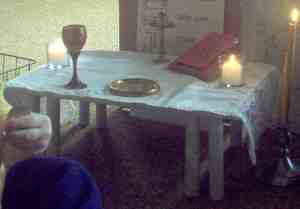
Altar Cloth and Linens - Click Image to Close

Quote from the acceptance letter:
"With your great Montessori background, it's easy to want to include many wonderful materials in the atrium, but especially in an atrium used for training, we need to be true to Sofia and Gianna's understanding of the essential."

I appreciate what is said here, but I have some concerns as well.

  • I came to Montessori THROUGH Catechesis of the Good Shepherd. Yes, I found Montessori first, but I had levels 1 and 2 formation in CGS before I went to AMI primary Montessori training. The above statement makes it sound as if Montessori came first. Then level 3 CGS and elementary Montessori training overlapped.

  • AMI is foundational. It does not participate in "fluff" and it too focuses on the essentials.

  • I have full respect for Sofia and Gianna, and I have equal respect for Maria Montessori. All three ladies focused on the essential with the children, yet Sofia and Gianna's work was founded on Maria Montessori's work. This is getting a bit into the chicken/egg syndrome, so the main point is that we canNOT separate the Montessori method from CGS without losing KEY QUALITIES.

  • Many of those foundational Montessori principles that are given in CGS formation courses (silence game, walking on the line) are losing their strength in the passing from one adult to the next. But when such exercises are fully present in the atrium, you find children who are centered (normalized), at peace, and working deeply.

  • For me personally, CGS informs my application of the Montessori method in the academics far more than Montessori affects my CGS work in the realm of faith formation. I am not necessarily taking the above comment personally, but I do feel it is a blanket statement that reflects a division between the two rather than a recognition of CGS's roots in Montessori - the condition of the roots reveals the condition of the potential flowering.


Some interesting tidbits on the relationship between CGS and academic Montessori - or how Montessori can and SHOULD apply to CGS:

  • Walking on the line and the silence activity are being watered down in CGS and the fruits are not forthcoming. These are *essential* Montessori principles that CGS needs to hold onto tightly, or it will become simply a mental exercise in religious education, such as Godly Play has become.

  • Evolution and Age of the Earth: The academic materials that inspired such level 2 works as the Fettuccia and Blue Unity and History of the Gifts - has NO MENTION of the specific number of years since the birth of the Earth.  Yet originally these CGS materials were made to represent a certain number of years and specifically TAUGHT evolution. I will not get into evolution versus creationism vs something in-between here. I will simply state that it is NOT the place of the atrium to get into this topic either. The atrium's place is to emphasize that God created the world and provided these gifts without mention of length of time. Let the children's imaginations, their schools and parents work it out. These modifications were finally made, but only after the Montessori community looked even further down on CGS for even trying to say that a rib on the grosgrain indicates 1,000 years - pure Montessori has no such material, neither should the atrium.

  • I have had SO MANY children struggle with the concept of going from a globe to this flat map of Israel, with little to no connection to where we are now (other than on the globe). This is an area that CGS atriums should be introducing a brief preliminary geography material. Starting with the globe, then a round ball of clay, cutting the clay into two (hemispheres) and rolling them flat to show the two halves of the earth on a flat surface; then showing the puzzle map of the world, with Israel and the atrium's locations marked.

  • We have Exercises of Practical Life in the atrium, but so many catechists are NOT focused on the Montessori essentials and they introduce "fluff" into the EPL area, at the same time they ignore what is most essential. Yes, the children need EPL. It fulfills developmental needs that allows the catechist to then get into the theological presentations. HOWEVER, transferring puff balls from one bowl to another is not necessary in the atrium, unless you have the children using tongs to get fresh cotton balls for the polishing work.


The tray on the left should be glass

or hard plastic; I was using it elsewhere

the day this photo was taken.


  • Polishing: I have personally streamlined my AMI album pages on glass, metal and wood polishing, so that ONE presentation can be given and the child now has all the polishing available to work on. The only differences are the actual polishes in the bottles, the type of tray, the ring and the dish for the polish and cotton ball - designed to indicate what that polish is to be used for.

  • There are a few ways that the Exercises of Practical Life within the atrium can be freshened up, so as to focus on the essentials, while meeting children's developmental needs, and leading more fully into the life of the atrium, the family and the church.

  • Last EPL thought: consider how the children are to be responsible for the atrium and the church; provide those materials (polishing, flower arranging, cleaning, sweeping, folding cloths (ie for the altar)). Consider what preliminary work they need in order to accomplish those works (eyedropper transfer for polishing, introductory cloth folding, carrying trays and mats). If you need a few more preliminaries at the beginning of the year, fine! Then pull them out by the second month of atrium so the children are not matching colors or transferring puff balls all year when they have other work that more fully meets their developmental needs.

  • Language: Some people add far more 3-part and 4-part cards than are entirely necessary. I fully agree with CGS's current materials manuals in how much they provide, with one exception: it is nice to have the 3-part cards for the cities of Israel for the level 1 children. But I have seen some people go much, much further and label *everything*. It gets to be too much.

  • Summary: So in many areas, the Montessori influence is not balanced. Too much or too little and both to the detriment of the potential of the album.


In all other aspects, CGS is separate from the academic Montessori, which includes something good and beautiful (we call it Cosmic Education ;) ), but is separate from CGS in that Catechesis of the Good Shepherd is theology at its richest and deepest.


I recognize what I would be doing in a formation course; but I wonder how I would go about assuring that stronger, balanced Montessori foundation.


Again, though, CGS has impacted how I do the academic portion of Montessori far more than my Montessori background will ever impact CGS.


Catechesis of the Good Shepherd and Montessori

Wow. I am still in shock.
As I reflect on the letter I received today (I am typing this on Friday afternoon), I thought I’d share some thoughts that answer some private questions I receive from time to time.
Basically, these questions center around the relationship between Catechesis of the Good Shepherd and Montessori education – for US. In OUR family.
Altar Cloth and Linens - Click Image to Close
Quote from the acceptance letter:
“With your great Montessori background, it’s easy to want to include many wonderful materials in the atrium, but especially in an atrium used for training, we need to be true to Sofia and Gianna’s understanding of the essential.”
I appreciate what is said here, but I have some concerns as well.
  • I came to Montessori THROUGH Catechesis of the Good Shepherd. Yes, I found Montessori first, but I had levels 1 and 2 formation in CGS before I went to AMI primary Montessori training. The above statement makes it sound as if Montessori came first. Then level 3 CGS and elementary Montessori training overlapped.
  • AMI is foundational. It does not participate in “fluff” and it too focuses on the essentials.
  • I have full respect for Sofia and Gianna, and I have equal respect for Maria Montessori. All three ladies focused on the essential with the children, yet Sofia and Gianna’s work was founded on Maria Montessori’s work. This is getting a bit into the chicken/egg syndrome, so the main point is that we canNOT separate the Montessori method from CGS without losing KEY QUALITIES.
  • Many of those foundational Montessori principles that are given in CGS formation courses (silence game, walking on the line) are losing their strength in the passing from one adult to the next. But when such exercises are fully present in the atrium, you find children who are centered (normalized), at peace, and working deeply.
  • For me personally, CGS informs my application of the Montessori method in the academics far more than Montessori affects my CGS work in the realm of faith formation. I am not necessarily taking the above comment personally, but I do feel it is a blanket statement that reflects a division between the two rather than a recognition of CGS’s roots in Montessori – the condition of the roots reveals the condition of the potential flowering.
Some interesting tidbits on the relationship between CGS and academic Montessori – or how Montessori can and SHOULD apply to CGS:
  • Walking on the line and the silence activity are being watered down in CGS and the fruits are not forthcoming. These are *essential* Montessori principles that CGS needs to hold onto tightly, or it will become simply a mental exercise in religious education, such as Godly Play has become.
  • Evolution and Age of the Earth: The academic materials that inspired such level 2 works as the Fettuccia and Blue Unity and History of the Gifts – has NO MENTION of the specific number of years since the birth of the Earth.  Yet originally these CGS materials were made to represent a certain number of years and specifically TAUGHT evolution. I will not get into evolution versus creationism vs something in-between here. I will simply state that it is NOT the place of the atrium to get into this topic either. The atrium’s place is to emphasize that God created the world and provided these gifts without mention of length of time. Let the children’s imaginations, their schools and parents work it out. These modifications were finally made, but only after the Montessori community looked even further down on CGS for even trying to say that a rib on the grosgrain indicates 1,000 years – pure Montessori has no such material, neither should the atrium.
  • I have had SO MANY children struggle with the concept of going from a globe to this flat map of Israel, with little to no connection to where we are now (other than on the globe). This is an area that CGS atriums should be introducing a brief preliminary geography material. Starting with the globe, then a round ball of clay, cutting the clay into two (hemispheres) and rolling them flat to show the two halves of the earth on a flat surface; then showing the puzzle map of the world, with Israel and the atrium’s locations marked.
  • We have Exercises of Practical Life in the atrium, but so many catechists are NOT focused on the Montessori essentials and they introduce “fluff” into the EPL area, at the same time they ignore what is most essential. Yes, the children need EPL. It fulfills developmental needs that allows the catechist to then get into the theological presentations. HOWEVER, transferring puff balls from one bowl to another is not necessary in the atrium, unless you have the children using tongs to get fresh cotton balls for the polishing work.
The tray on the left should be glass
or hard plastic; I was using it elsewhere
the day this photo was taken.
  • Polishing: I have personally streamlined my AMI album pages on glass, metal and wood polishing, so that ONE presentation can be given and the child now has all the polishing available to work on. The only differences are the actual polishes in the bottles, the type of tray, the ring and the dish for the polish and cotton ball – designed to indicate what that polish is to be used for.
  • There are a few ways that the Exercises of Practical Life within the atrium can be freshened up, so as to focus on the essentials, while meeting children’s developmental needs, and leading more fully into the life of the atrium, the family and the church.
  • Last EPL thought: consider how the children are to be responsible for the atrium and the church; provide those materials (polishing, flower arranging, cleaning, sweeping, folding cloths (ie for the altar)). Consider what preliminary work they need in order to accomplish those works (eyedropper transfer for polishing, introductory cloth folding, carrying trays and mats). If you need a few more preliminaries at the beginning of the year, fine! Then pull them out by the second month of atrium so the children are not matching colors or transferring puff balls all year when they have other work that more fully meets their developmental needs.
  • Language: Some people add far more 3-part and 4-part cards than are entirely necessary. I fully agree with CGS’s current materials manuals in how much they provide, with one exception: it is nice to have the 3-part cards for the cities of Israel for the level 1 children. But I have seen some people go much, much further and label *everything*. It gets to be too much.
  • Summary: So in many areas, the Montessori influence is not balanced. Too much or too little and both to the detriment of the potential of the album.
In all other aspects, CGS is separate from the academic Montessori, which includes something good and beautiful (we call it Cosmic Education ;) ), but is separate from CGS in that Catechesis of the Good Shepherd is theology at its richest and deepest.
I recognize what I would be doing in a formation course; but I wonder how I would go about assuring that stronger, balanced Montessori foundation.
Again, though, CGS has impacted how I do the academic portion of Montessori far more than my Montessori background will ever impact CGS.

Sunday, September 9, 2012

Wishing to be sick !?

On Saturday, I was feeling so psychologically tired (should have been a sign I was getting sick), that I actually wished to be sick. Yep. I really wanted to be sick. Just so I could have an excuse to lay in bed all day. Because I knew I wouldn't do it unless I were forced to - there is just too much work to do right now to lay around. Even if God gave us a day a week for total rest, I need something more (!?) to justify it. Go figure.

Well... as the saying goes.

Be careful what you wish for.

Thursday, July 26, 2012

Out of chocolate syrup...

When you're out of homemade, HFCS-free homemade chocolate syrup, but you need a fix for your ice cream....

one spoon of sugar...

one spoon of powdered cocoa...

and a few drops of vanilla...

Add the ice cream.

MMMMMMMMMMMMMMMMMMMM................................

;)

(notice the lack of photo of the ice cream! It's GONE!)

Wednesday, July 4, 2012

In Full Bloom: Our Balcony Garden

Ok, two things are in bloom!

But it's ALL so beautiful!

(note to Grandma: please click on each image to see it full-size - the settings here cut down the photos) :)

[gallery order="DESC" link="file" columns="2" ids="834,835,836,837,838,839,840,841,842,843,844,845,846,847,848,849,850,851,852,853,854,855,856,857,858,859,860,861"]
Enhanced by Zemanta

Tuesday, June 19, 2012

The Merchant Retires

8 years ago I quick-created a cardboard merchant for the Parable of the Precious Pearl - to use the next day in our brand new Catechesis of the Good Shepherd atrium at my then-current parish.

He resided there for 2 years before coming home for the summer, then moved across the country with me for one year, used in our home atrium before making another cross-country trek to our current residence; where he took up residence in a local atrium which I set up 4 years ago.

This past week the parish hosted a level 1 formation course and as the formation leader presented each material, the current CRE and I would make corrections, additions and other adjustments to the materials present. To both of our surprises, it never dawned on us that a Merchant environment had *never* been created! The catechists would pull other temporary materials when giving the presentation and the children just didn't reciprocate - they look at the pearl, utilize the tracing packet and move the merchant around a bit.

Yep. Time for a merchant environment.

But then I got to looking at the merchant. He looks so tired. His upheld hand is loose at the wrist; all corners and edges are curling.

Really. He was created 8 years ago, out of cardboard; there is a slit in the bottom base cardboard to hold him in with glue. He was GREAT! He is STILL great!

But it is time for retirement. There were wooden merchants already available (just not finished tracing the outline; nor painted), so replacing him was easy.

It is just sort of bittersweet to see this precious figure, 8 years old and still going. I admit to having difficulties just throwing him away. I want to give him a proper burial. Is that sad? Or is that a beautiful testament to the fact that this material has been utilized as a tool to draw a child - many children - deeper into the mystery of the Kingdom of God?
The Kingdom of God is like a merchant in search of fine pearls. When he finds one pearl of great value, he goes and sells everything he has and buys the one precious pearl.

Simple words. Simple material. Profound depth.


Enhanced by Zemanta

Saturday, June 16, 2012

Adolescent Montessori Discussion Group

Erdkinder refers to the farm school for the adolescent Montessori child; and there is even more to it!


With so much growth at the elementary level, we have more and more families looking to do Montessori at the adolescent ages at home as well.

I am putting together a small online discussion group specifically for this age, with reading assignments on a suggested schedule, discussion topics and sharing of ideas and resources. Everything will be from a homeschool perspective, but classroom teachers are welcome and encouraged to join in as well.

If you are part of our Keys of the Universe discussion board, you are already in! I will begin the official group June 21 in the adolescent section and Keys of the Universe participants have full access as part of their regular participation.

If you are not part of the Keys of the Universe discussion board, join us here:

Keys of the Universe Individual Album Support - Adolescent Montessori Discussion Group Access

One-time payment; life-time participation

We will begin June 21 in earnest; but join now so you're ready to go when I post the first discussion topic.

The ideal participant:

  • you have a child age 10-16 right now, with or without elementary Montessori experience

  • you have an older child and would like to contribute from that perspective

  • you have Montessori adolescent experience

  • you have extensive other experience working with the adolescent group and you are familiar with Montessori principles; and want to apply those principles to the adolescent group


Anyone with any age child can be participate, but the earliest stages of this group will be better suited for someone in the field right now or very soon; or who has been there and can provide some insight, as we are going to share ideas, insights and develop resources as we go.


If you are looking for something totally put together with all the answers handed to you - we're not there yet! This initial group is for those who want to explore and share, together.


Goals - Main Topics:

  • establish foundation of understanding of the adolescent age

  • including their needs, tendencies; how to meet them

  • difference between societal expectations and reality of needs and tendencies

  • What if we provide all that Montessori suggested? What will happen?

  • Compare our own experiences and work through personal barriers.

  • Establish the universal principles of an adolescent Montessori homeschool

  • Lend support to filling in the specifics for each individual home

  • Establish collection of resources for use by homeschooling families for this age


Already part of Keys of the Universe: no cost

Join separate from Keys of the Universe: $15 - permanent access


Outline of the discussion group is coming soon, but a general overview of each week follows:

  • Reading assignment will be posted to the group

  • During your reading, note your reactions.

  • For the next day or so, observe around you and consider your past experiences - how do your experience match or contradict the reading?

  • Respond to the discussion board with whatever you are comfortable sharing.

  • Also respond with how you might respond to what you have explored in the reading and reflection.

  • Develop conversations on the adolescent age, such that we are working out the practical how-tos and what does it look like.


Reading assignments: some will be posted on the group; and some will come from the book Childhood to Adolescence; other reading sources will be listed as soon as possible. You will want to purchase this book if at all possible.


Come join us!


See you there!


Enhanced by Zemanta