Showing posts with label montessori. Show all posts

Friday, November 30, 2012

Montessori and Original Sin

One day, I gathered all my notes to write something about Montessori and Catholicism – specifically Original Sin, since this seems to be a huge sticking point – if Montessori sees only the good in a child, what about Original Sin? And what about “breaking the will”? And how could we dare just “follow the child” because their errant ways will only lead to more errant ways if they have complete freedom!
Well, besides issues of the balance of freedom and responsibility which is inherent in all properly Montessori environments, and the fact that we follow the child only within a prepared environment full of only good choices, I might mention that Montessori emphasizes time and again that when once a negative action or behavior shows itself we nip in the bud – no warnings, no 1-2-3-Magic, no “reasoning” with the 3 year old. But no strict harsh punishments either – we simply stop the behavior and move on. Don’t LET those bad habits develop! As the child ages, more reasoning can occur, but by then, the child has been formed in many good habits and the negative things that come up can be dealt with as they happen. Anyone who says that a young child cannot then possibly reveal anything beautiful and holy to us adults, is not obeying the Lord’s words, “Let the little children come to me, for heaven belongs to such as them.” Hm. Original Sin. Yet heaven belongs to the children, not to adults.
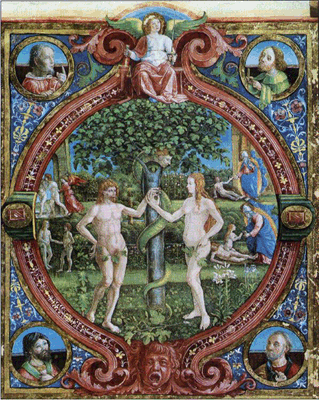
But someone else has said all of this so much better than I could! In googling to find more information and supportive documentation, I found the following site (please visit to read the full article) and I LOVE this paragraph in particular:
http://www.catholic.net/index.php?option=dedestaca&id=3541
Montessori held and applied the Catholic teaching that man was not completely corrupt with the Fall. She said that “in spite of the moral disorder brought about by original sin, there still remains in human nature a great potentiality for goodness.” Montessori used the analogy of wheat in the field to make a point about the natural goodness latent in all children. (51) Inferior wheat plant can grow in the fields without cultivation. Destroying them does not guarantee a good harvest. If the good wheat is to grow it must be cultivated and if it is, the inferior wheat seed will not be able to grow. Montessori says: “The key to the problem is, therefore, not to destroy evil but to cultivate good.” (53) Thus allowing the roots of good to sprout in the child´s soul.
And there are all of her own writings – if you read them in full context, they explain themselves! Be sure to look for older publications as somewhere in the 60s, many of her books were re-printed with huge religious sections removed. So newer printings have been heavily secularized.
………………………………………………..
And then I found these:
http://www.nsmontessori.com/NSMCH2.htm
To ignore the child’s spiritual nature is to ignore the very essence and purpose of education.
It is important, in this light, to make Dr. Montessori’s understanding of the nature of the child clear.  She considered the child to be good, but broken.  The child is good in that he is created to be good, and broken in that he is subject to the effects of Original Sin – as St. Paul lamented in his own behavior – not doing the things he wants to do and doing the things he does not want to do.  Her method, she believed, removed many of the obstacles that result in frustration which causes children to lose focus on learning and therefore display ‘broken’ behavior.  By freeing the child from these frustrating obstacles, the child becomes able to develop naturally and normally as God had planned.  This process she called ‘normalization’.
“Experience has shown that normalization causes the disappearance of many childish traits, not only those which are considered to be defects but also others which are generally thought to be virtues…  The disappearance of these childish characteristics shows that the true nature of a child has hitherto not been understood.  The universality of this fact is striking, but not entirely new since from the earliest times a twofold nature has been recognized in man.  The first was given him at the time of his creation.  The second came as a consequence of his first sin, a violation of God’s law.  Because of the fall, man was deprived of the blessings of his earlier state and left to the mercy of his surroundings and the illusions of his own mind.  This doctrine of original sin can help us understand what happens to a child.”(3)
http://www2.talbot.edu/ce20/educators/view.cfm?n=maria_montessori
(an article about the development of her spirituality)
Montessori in 1948 is reported to have lectured in London where she stated:
I see it-this Original Sin-who would not see a thing so evident? In the depths of the human soul is the possibility of continuous decadence…In fact, there are innate tendencies in man’s soul which lead to maladies of the spirit sometimes even unknown to ourselves, just as the germs of disease may work silently, and unknown. This is the death of the spirit which brings insensibility with it. These tendencies come from the soul itself and not from the environment

Friday, September 21, 2012

Catechesis of the Good Shepherd and Montessori

Wow. I am still in shock.
As I reflect on the letter I received today (I am typing this on Friday afternoon), I thought I’d share some thoughts that answer some private questions I receive from time to time.
Basically, these questions center around the relationship between Catechesis of the Good Shepherd and Montessori education – for US. In OUR family.
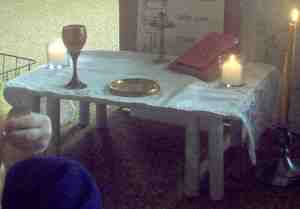
Altar Cloth and Linens - Click Image to Close
Quote from the acceptance letter:
“With your great Montessori background, it’s easy to want to include many wonderful materials in the atrium, but especially in an atrium used for training, we need to be true to Sofia and Gianna’s understanding of the essential.”
I appreciate what is said here, but I have some concerns as well.
  • I came to Montessori THROUGH Catechesis of the Good Shepherd. Yes, I found Montessori first, but I had levels 1 and 2 formation in CGS before I went to AMI primary Montessori training. The above statement makes it sound as if Montessori came first. Then level 3 CGS and elementary Montessori training overlapped.
  • AMI is foundational. It does not participate in “fluff” and it too focuses on the essentials.
  • I have full respect for Sofia and Gianna, and I have equal respect for Maria Montessori. All three ladies focused on the essential with the children, yet Sofia and Gianna’s work was founded on Maria Montessori’s work. This is getting a bit into the chicken/egg syndrome, so the main point is that we canNOT separate the Montessori method from CGS without losing KEY QUALITIES.
  • Many of those foundational Montessori principles that are given in CGS formation courses (silence game, walking on the line) are losing their strength in the passing from one adult to the next. But when such exercises are fully present in the atrium, you find children who are centered (normalized), at peace, and working deeply.
  • For me personally, CGS informs my application of the Montessori method in the academics far more than Montessori affects my CGS work in the realm of faith formation. I am not necessarily taking the above comment personally, but I do feel it is a blanket statement that reflects a division between the two rather than a recognition of CGS’s roots in Montessori – the condition of the roots reveals the condition of the potential flowering.
Some interesting tidbits on the relationship between CGS and academic Montessori – or how Montessori can and SHOULD apply to CGS:
  • Walking on the line and the silence activity are being watered down in CGS and the fruits are not forthcoming. These are *essential* Montessori principles that CGS needs to hold onto tightly, or it will become simply a mental exercise in religious education, such as Godly Play has become.
  • Evolution and Age of the Earth: The academic materials that inspired such level 2 works as the Fettuccia and Blue Unity and History of the Gifts – has NO MENTION of the specific number of years since the birth of the Earth.  Yet originally these CGS materials were made to represent a certain number of years and specifically TAUGHT evolution. I will not get into evolution versus creationism vs something in-between here. I will simply state that it is NOT the place of the atrium to get into this topic either. The atrium’s place is to emphasize that God created the world and provided these gifts without mention of length of time. Let the children’s imaginations, their schools and parents work it out. These modifications were finally made, but only after the Montessori community looked even further down on CGS for even trying to say that a rib on the grosgrain indicates 1,000 years – pure Montessori has no such material, neither should the atrium.
  • I have had SO MANY children struggle with the concept of going from a globe to this flat map of Israel, with little to no connection to where we are now (other than on the globe). This is an area that CGS atriums should be introducing a brief preliminary geography material. Starting with the globe, then a round ball of clay, cutting the clay into two (hemispheres) and rolling them flat to show the two halves of the earth on a flat surface; then showing the puzzle map of the world, with Israel and the atrium’s locations marked.
  • We have Exercises of Practical Life in the atrium, but so many catechists are NOT focused on the Montessori essentials and they introduce “fluff” into the EPL area, at the same time they ignore what is most essential. Yes, the children need EPL. It fulfills developmental needs that allows the catechist to then get into the theological presentations. HOWEVER, transferring puff balls from one bowl to another is not necessary in the atrium, unless you have the children using tongs to get fresh cotton balls for the polishing work.
The tray on the left should be glass
or hard plastic; I was using it elsewhere
the day this photo was taken.
  • Polishing: I have personally streamlined my AMI album pages on glass, metal and wood polishing, so that ONE presentation can be given and the child now has all the polishing available to work on. The only differences are the actual polishes in the bottles, the type of tray, the ring and the dish for the polish and cotton ball – designed to indicate what that polish is to be used for.
  • There are a few ways that the Exercises of Practical Life within the atrium can be freshened up, so as to focus on the essentials, while meeting children’s developmental needs, and leading more fully into the life of the atrium, the family and the church.
  • Last EPL thought: consider how the children are to be responsible for the atrium and the church; provide those materials (polishing, flower arranging, cleaning, sweeping, folding cloths (ie for the altar)). Consider what preliminary work they need in order to accomplish those works (eyedropper transfer for polishing, introductory cloth folding, carrying trays and mats). If you need a few more preliminaries at the beginning of the year, fine! Then pull them out by the second month of atrium so the children are not matching colors or transferring puff balls all year when they have other work that more fully meets their developmental needs.
  • Language: Some people add far more 3-part and 4-part cards than are entirely necessary. I fully agree with CGS’s current materials manuals in how much they provide, with one exception: it is nice to have the 3-part cards for the cities of Israel for the level 1 children. But I have seen some people go much, much further and label *everything*. It gets to be too much.
  • Summary: So in many areas, the Montessori influence is not balanced. Too much or too little and both to the detriment of the potential of the album.
In all other aspects, CGS is separate from the academic Montessori, which includes something good and beautiful (we call it Cosmic Education ;) ), but is separate from CGS in that Catechesis of the Good Shepherd is theology at its richest and deepest.
I recognize what I would be doing in a formation course; but I wonder how I would go about assuring that stronger, balanced Montessori foundation.
Again, though, CGS has impacted how I do the academic portion of Montessori far more than my Montessori background will ever impact CGS.

Saturday, June 16, 2012

Adolescent Montessori Discussion Group

Erdkinder refers to the farm school for the adolescent Montessori child; and there is even more to it!


With so much growth at the elementary level, we have more and more families looking to do Montessori at the adolescent ages at home as well.

I am putting together a small online discussion group specifically for this age, with reading assignments on a suggested schedule, discussion topics and sharing of ideas and resources. Everything will be from a homeschool perspective, but classroom teachers are welcome and encouraged to join in as well.

If you are part of our Keys of the Universe discussion board, you are already in! I will begin the official group June 21 in the adolescent section and Keys of the Universe participants have full access as part of their regular participation.

If you are not part of the Keys of the Universe discussion board, join us here:

Keys of the Universe Individual Album Support - Adolescent Montessori Discussion Group Access

One-time payment; life-time participation

We will begin June 21 in earnest; but join now so you're ready to go when I post the first discussion topic.

The ideal participant:

  • you have a child age 10-16 right now, with or without elementary Montessori experience

  • you have an older child and would like to contribute from that perspective

  • you have Montessori adolescent experience

  • you have extensive other experience working with the adolescent group and you are familiar with Montessori principles; and want to apply those principles to the adolescent group


Anyone with any age child can be participate, but the earliest stages of this group will be better suited for someone in the field right now or very soon; or who has been there and can provide some insight, as we are going to share ideas, insights and develop resources as we go.


If you are looking for something totally put together with all the answers handed to you - we're not there yet! This initial group is for those who want to explore and share, together.


Goals - Main Topics:

  • establish foundation of understanding of the adolescent age

  • including their needs, tendencies; how to meet them

  • difference between societal expectations and reality of needs and tendencies

  • What if we provide all that Montessori suggested? What will happen?

  • Compare our own experiences and work through personal barriers.

  • Establish the universal principles of an adolescent Montessori homeschool

  • Lend support to filling in the specifics for each individual home

  • Establish collection of resources for use by homeschooling families for this age


Already part of Keys of the Universe: no cost

Join separate from Keys of the Universe: $15 - permanent access


Outline of the discussion group is coming soon, but a general overview of each week follows:

  • Reading assignment will be posted to the group

  • During your reading, note your reactions.

  • For the next day or so, observe around you and consider your past experiences - how do your experience match or contradict the reading?

  • Respond to the discussion board with whatever you are comfortable sharing.

  • Also respond with how you might respond to what you have explored in the reading and reflection.

  • Develop conversations on the adolescent age, such that we are working out the practical how-tos and what does it look like.


Reading assignments: some will be posted on the group; and some will come from the book Childhood to Adolescence; other reading sources will be listed as soon as possible. You will want to purchase this book if at all possible.


Come join us!


See you there!


Enhanced by Zemanta

Saturday, February 11, 2012

Reading Programs We Like

Caveat: I'm a Montessorian (and an AMI keys-based one at that) - so I'm not keen on any reading program in its entirety.

See this blog post over at Montessori Nuggets about learning to read steps for children without severe other issues going on.

Keys of the World will soon be offering a keys-based Montessori guide to reading (i.e. it does not use the pink/blue/green (and now purple?) reading series - which can be used as a supplement if you so choose ;) ).

However, I have found the following resources quite helpful in particular situations:

  • Catholic Heritage Curricula - Little Stories for Little Folks

    • Each story focuses on specific skill sets - so little bits at a time. There are word/letter games as well as opportunities for drawing, coloring and vocabulary-building.

    • If you're not Catholic, they're still great in their step by step, keys-approach to reading. The stories more intrinsic to the Catholic faith that can be modified or removed, assuring you cover the "new" material in another way.

    • Follow up with their supplemental readers if you like (corresponding with specific levels) as children plateau at the various stages, then Bigger Stories for Little Folks, Devotional Stories for Little Folks, Devotional Stories for Little Folks Too, all of which follow a Catholic homeschooling family through the usual experiences of family life.

    • Scripture and church life are included.

    • These are great for learning to read, moving ahead pretty quickly, then going back to "review" but have the child read the earlier levels aloud to ensure pronunciation and practice voice tones, inflections and other read-aloud skills - with words they already know and understand.


  • Christian Light Publications - Learning to Read and Reading to Learn series

    • Gentle faith-based stories without being preachy in any way; illustrations are of Mennonites; can be used by families of any faith

    • Includes poetry, stories and Bible passages

    • Vocabulary sections teach dictionary pronunciation in the earliest levels - a very nice feature, especially from a Montessori perspective

    • The included light-units are easily modified for use by a Montessori student using these only as a supplement, or can be completed in their entirety (my son did them all! He loved them!)

    • Heavy emphasis is placed on reading comprehension not just reading skill - also a nice feature from a Montessori perspective - children may be able to read and understand the stories of upper levels with ease, but the light-units encourage the child to really think about what is going on.


  • My son and I even used the Bob Books (I thought I'd never use them! But I'll admit - Montessori-wise, they use the line drawings, they entice a kindergartner's sense of humor and they are easy for the child to re-create).

    • We modified them a bit and turned them into a reading *activity*.

    • I photocopied them onto plain paper, and cut the words from the picture.

    • He would read through the booklet; then take the copies and match up each line of words to the corresponding picture.

    • This is a very Montessori-like activity done much more inexpensively (we bought the Bob books used)

    • While it helps with reading comprehension, even adding this activity, does not make the Bob books a complete learning to read series on its own. The child could memorize the shape of the words or have a photographic memory to know the length of the lines on each page. So this is where reading-aloud after some silent reading practice with the booklet comes into play.


    Would I recommend anything else? No not really. I've used other programs, series, games, curricula, and never been satisfied. They are all too gimmicky or chore-like, inappropriate for the ages intended, and modifications are difficult.

    While none of the above are complete-enough in my estimation, they serve a very strong purpose and I can recommend them in their entirety, without qualms; but I do not say they are complete by themselves; they all must be part of a life that includes daily life experiences in reading: recipes, lists, notes from parents and siblings, cards from relatives and friends, street signs, reading for enjoyment, and any other reading that takes place in a typical daily life for that particular child. Combined with the tips at Montessori Nuggets, and a solid keys-based approach to reading, there is no reason a normally developing child should not be reading at a second grade reading level or higher within 2 months of starting to put two sounds together in the same word.

      Thursday, January 12, 2012

      Montessori Nuggets

      A new Montessori blog! Now most Montessori posts will be over there and this blog can focus back on our own homeschooling and life happenings :)

      Montessori Nuggets: Daily Montessori Treasures

      [caption id="" align="alignright" width="300" caption="Image via Wikipedia"]Les Périodes Sensibles de la Pédagogie Montessori[/caption]

      You can sign up for an e-mail feed and receive a Montessori Nugget in your e-mail each day.

      Most posts will be relatively short and to the point. More information can be found via various theory papers, in the albums I'll be soon offering for sale (yay!), other locations on the internet, in Maria Montessori's books, or in the elementary Montessori online training at Keys of the Universe.
      Enhanced by Zemanta

      Sunday, October 30, 2011

      Heights and Depths of Geography

      What is geography? What do you think of when you hear the word geography?

      Memorizing the names of countries and capitals? Labeling maps?

      Perhaps you go a bit further and consider the trade that occurs within countries and between countries?

      Or perhaps you are familiar with the 5 themes of geography or the 18 standards that replaced the 5 themes found at the National Council for Geographic Education.

      Geography is even more!
      Geography is the study of the earth and its living creature; the earth's place within the universe, the depths of the earth, the heights of the atmosphere and those things joined to the earth naturally or through man-made means.

      Geography studies the layers of the earth, the life that lives in every area, the moon that orbits the earth, the cultures of people who live in each region, and still more.

      To receive a full scope of all that geography entails, let us look to how the Montessori method presents geography, within a context of cosmic education:the idea that all subjects are inter-related so no subject is truly taught in isolation:

      The youngest children (the infants and toddlers) are first given their own culture: mother and father's loving arms, the stories they tell, their ways of speaking and interacting.


      [caption id="attachment_490" align="alignleft" width="150" caption="Sample of a primary Montessori puzzle map"][/caption]

      Primary children (ages 3-6) are participating more and more in that culture, really honing in on the exercises of practical life (designed to suit their particular culture, and as they reach ages 5 and 6, exposure to the practical life of other cultures). They are given globes to show land and water, then the continents, then the oceans, then the climactic zones. Puzzle maps of the world and of the continents are designed to not only show general placement, but to show the location of the capitals (each continent map has its knob approximately at the capital of that country). Flags for each country, cultural folders (or drawers), exposure to other languages, stories and books about children from around the world, lead the children on an exploration of the keys of the world - their world, where differences and similarities are equally celebrated.

      [caption id="attachment_491" align="alignright" width="225" caption="Perpendicular and Oblique Rays of the Sun"][/caption]

      Elementary children (ages 6-12) are now ready to take on the universe. We begin geography and history with the First Great Lesson: the Story of God with No Hands (or the Creation of the Universe Story). This story introduces the layers of the earth, states of matter, the beginning of time, universal laws and the obedience of all created things to that law. Subsequent lessons within geography present laws of gravity, physics, astronomy, geology, culture, economics, and more.


      The table of contents for the elementary Montessori geography album includes the following (note that this list does not include each of the sections within each presentations, which can span anywhere from 2 to 10 sessions, within any given week or over the course of 1-6 years; also astronomy has been separated into a separate album according to Keys of the Universe Elementary Montessori albums):

      Elementary Montessori Geography

      Introduction to Geography
      -Practical Considerations for the Experiments
      -Notes on the Experiments
      -Command Cards
      -Geography Nomenclature
      Chapter I: Creation of the Earth/Idea of the Universe
      -God with No Hands
      -Experiments with God with No Hands
      -Notes on the Story
      -Follow-Ups to the Story
      -Composition of the Earth
      -Further Details of the Composition of the Earth
      -Formation of the Mountains
      Chapter II: Nature of the Elements
      -Three States of Matter
      -Further States of Matter
      -Different Ways of Combining
      -Separation, Saturation, Super-saturation
      -Attraction and Gravity
      Chapter III: The Sun and the Earth
      -Rotation of the Earth and Its Consequences
      -Time Zone Chart
      -Earth as a Sphere and Its Result
      -Tilt of the Axis
      -Seasons and the Two Tropics
      -The Zones
      -Zones’ Work Chart
      -Protractor Chart
      -Seasons Work Chart
      -Protection of the Atmosphere and the Rains
      Chapter IV: The Work of Air
      -Experiments Prelude to the Winds
      -The Winds
      -Land and Sea Breezes
      -Changes in the Winds Caused by the Seasons
      -Rains
      -Work Chart of the Winds
      -Ocean Currents Caused by Winds
      -Wind as a Sculptor
      Chapter V: The Work of Water
      -The River
      -The Rains
      -Ocean Waves
      -Ice
      -Water Cycle
      -Spread of Vegetation
      -People in Different Zones
      Chapter VI: Human Geography
      -Interdependence of Human Beings in Society
      -Economic Geography
      Chapter VII: Functional Geography
      -Map work
      Enhanced by Zemanta

      Friday, October 14, 2011

      Montessori Albums - Primary, Elementary, Infancy

      Montessori albums - album pages - album write-ups - huh? What ARE all of these people talking about? Are they doing some sort of scrapbooking in Montessori training?

      And where do we get the lesson plans for doing the Montessori activities? The Montessori curriculum?

      Aha! It's all the same!

      When a person goes to a fully certified Montessori training course, they receive each presentation as an actual presentation - the instructor generally uses a trainee from the course group and shows the student the work at hand as if the trainee were a child in that age range. Everyone else observes.

      The student then goes back to their seat and the instructor goes through the presentation step-by-step, discussing points when needed, while the trainees (furiously) write or type out as much as they possibly can.

      When they go home that evening, they type it all up, or re-format it so it's pretty; add illustrations - either photographs or drawings or artwork or a combination; along with the 20 or so other presentations received that day.

      These are each called an "album page."

      As album pages are compiled into their respective albums, there becomes an album for each subject area:

      • Primary - Exercises of Practical Life, Sensorial, Language, Mathematics (and Theory)
        • (some trainings will break out art, geography, and some sciences; most AMI trainings keep these areas interspersed among the four *key* albums)
      • Elementary - Mathematics, Language, Geography, Biology, Music, Geometry, History
        • (yes geometry is separated from the mathematics; geography includes astronomy and geology; biology includes zoology and botany; and yes some trainings split things out and some combine things back together - ie art in this case)


      The album pages are reviewed by "readers" and corrections are made. The final corrections are assembled into the albums, which are decorated as the trainee sees fit. They then go for a final reading before the trainee studies for their final exams.

      See now why so many Montessori-trained people like to stick to their albums so much? They are full works of art, blood may have gone into creating them! and certainly a lot of time, energy, sweat, and tears went into their creation.

      And they still end up with typos! Sigh ;)

      Now - are you looking for something to download online? There are many options available (one post couldn't hold the entire list of options!) - both paid and free; purchase hard-copy or download a file of them.

      Looking to do complete or almost all Montessori? What you *really* want is to get all the albums from the same place, so that they are cohesive.

      If you're just looking to supplement a particular topic within a subject, individual album pages are perfect for you. If you're looking to do most or all of an entire subject, you'll want to get the entire album from one place. There are enough differences that the discrepancies become HUGE when you are pulling information from so many different sources.

      Yes, the Montessori philosophy is the same, but you want a cohesiveness to the materials and the presentations, and since there *is* some wiggle room, downloading an entire subject (let's say Math) from 5 different sources is going to prove more frustrating and time-consuming that it needs to be.

      So pick one or two, and stick with it. You'll be happy you did! The process of material gathering will be simplified, where to put each presentation, what materials can overlap, and which you need to duplicate.

      Keys of the Universe has complete elementary Montessori albums, online support, a choice of "course lengths", is affordable ($20/month or $40/month), and is flexible if you need to take time off, or just want to hold off on the next sets, or need to do so for budget reasons.  Plus you get the permanent discussion community so that if you have any questions or concerns, you have access at any time. Come visit!


      Friday, July 22, 2011

      Keys of the Universe Online Elementary Montessori

      .... is now available!

      Come visit us at Keys of the Universe

      Homeschoolers wanting to start Montessori in the elementary years, or continue Montessori from the primary years into the elementary in your homeschool?

      School teachers, whether Montessori or traditional or otherwise that want to incorporate Montessori principles?

      Don't have access or time for a fully-certifying Montessori training?

      Looking for something fascinating, thought-provoking, with lots of support via a group discussion community and a private mentor, as well as homeschool support, discounts on downloadable materials, and *more* ---- all online and available at any time *your schedule allows?

      Come Visit!

      See you there!

      :)
      Enhanced by Zemanta